Memories of Geshe Dugda
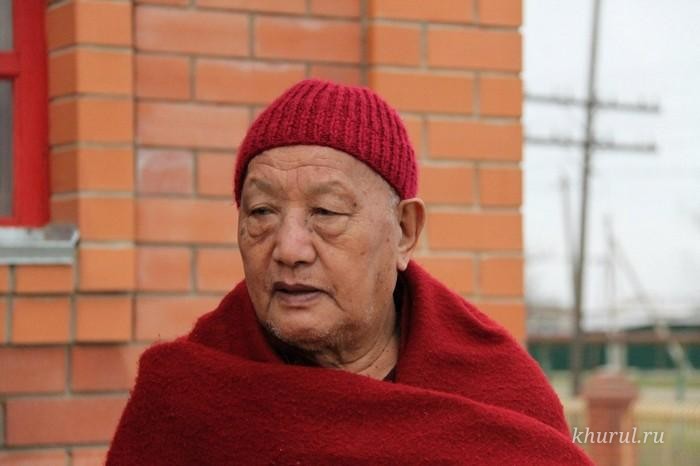
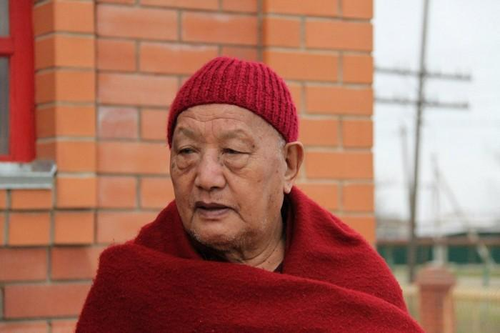
I first heard about Geshe Dugda from my uncle when I was preparing to enter the Central Khurul as a novice in the spring of 2001. “In the khurul there is an old Bagsha who can give you the oral transmission (lung) for reciting the mantra of Buddha Shakyamuni, and he is your patron according to your year of birth,” he instructed me. It was Geshe Dugda, as the most senior and knowledgeable monk in the khurul, who made the decision to accept me as a novice. Geshe-la seemed very strict to me at first; we were a little afraid of him — it felt as though he could see right through you, all your thoughts. It seemed to me that he was at such a height of spiritual development that it was difficult for me even to imagine what he was thinking about. From Geshe-la I received both the manjika vows and the getsul vows. Geshe Dugda was an unquestioned authority in the khurul; it was only later, already in Gomang, that I learned that he was one of the so-called “Bagsa largens” (that is, the elders of the community who had spent time in the place called Bagsa in North India, the first gathering place of the monks of the largest philosophical monasteries who came from Tibet), and that it was upon his generation and that of Geshe Jamyang Khyentse that the most difficult trials fell, when they had to rebuild the monastery from scratch, working tirelessly while still managing to go through the study program in the evenings. The feat of that generation of monks is still remembered and recounted to young monks in Gomang, for it was thanks precisely to their selfless labor that the monastery was able to grow strong and develop to its present state. It is quite possible that because of these many years of effort, of a lack of proper sleep and nourishment, Geshe-la developed heart problems later on. From Geshe-la’s accounts of himself, it is known that he was born in the place called Tsumo in southern Tibet in 1938. At the age of 15 he became a monk in the local monastery of Tsumo Dunkar. In 1959 he left Tibet, which had been seized by the Chinese communists, and spent 8 years in the monastery of Iga Choling (better known as “Old Ghoom monastery”), founded by the Mongolian monk Sherab Gyatso in 1850 in the vicinity of Darjeeling in West Bengal. All those years the young monk understood that for serious Buddhist practice, deep knowledge of Buddhist philosophy is necessary, and in 1967 he set out for the place called Bagsa, where the monks of the three largest philosophical monasteries of Tibet — Drepung, Sera, and Ganden — who had fled from Tibet were temporarily based. Two years later the government of India allotted land to the Tibetan refugees in the south of the country, in the state of Karnataka, and the monks of Gomang Datsan, where he had enrolled to study, set off there to begin building their monastery from scratch. In the first years the monks were forced to work in the fields during the day, clearing the jungle, then in the afternoon to construct buildings for the future monastery, and only after sunset to attend classes and hold study debates late into the night. In the morning, after a short sleep, they would set off to work again. After some time, through the efforts of every member of the community, the monastery was able to gain a measure of financial independence, and the monks were able to devote more time to the study process. In 1992 Tenzin Dugda defended the highest monastic scholarly degree of Geshe Lharampa and traditionally spent one year at the tantric monastery of Gyume. After that he was appointed monastic disciplinarian at Gomang, and in 1995, at the request of the abbot and at the invitation of Telo Rinpoche, he set off for distant Kalmykia. For 17 years, right up until his passing in 2012, Geshe Dugda was a support for everyone who turned to him for help. He knew well not only Buddhist philosophy but also many of the subtleties associated with the building of stupas and the performing of rituals. Legends still circulate among the people about the power of the rituals he performed. We did not associate closely with him, perhaps because of the language barrier (my Tibetan back then was at the level of “tashi delek — kare che gyö”), or perhaps because of the colossal difference in spiritual development that lay between us. But I always felt his care for us. In 2012, at the beginning of the year, I returned from India to renew my visa and went to visit Geshe-la. Before that, after the three-day consecration ritual of the Golden Abode, in which he wished to participate despite his state of health (perhaps it was a conscious step, to sum up all his many years of activity for the benefit of Kalmykia — a farewell chord), he had suffered a heart attack and was at home. The doctors had recommended complete rest for him. Then I offered him a khadak and told him that I was already finishing the Paramita course; he nodded approvingly and said, “very good.” I noticed that he had a very distant gaze, as though in his thoughts he was already not with us, but there, where he was soon to depart. His passing deserves a separate account, which I think was in itself a demonstration of the true level of his practice, which many perhaps did not even suspect during his lifetime. After some time a tumor was discovered in Geshe-la’s stomach, and he decided to undergo an operation, despite the danger that his heart simply would not withstand the anesthesia. He came out of the anesthesia after the operation and was even due to be transferred on March 13 from intensive care to the general ward, when his heart stopped. They tried to resuscitate him, but in vain. The doctors recorded the fact of death. The cremation was scheduled for the third day. His body was transported from the hospital to his home so that his students and all who knew him could pay their respects and bid farewell to Geshe-la. Two days later, after no signs of decomposition had been discovered, following a council of the monks of the khurul, it was decided to postpone the cremation until they clearly appeared. In the Buddhist tradition there is the concept of “tugdam,” the so-called “post-mortem meditation,” when all the coarse external signs of life — breathing, heartbeat, and so on — have disappeared, but the subtlest consciousness has not yet left the body. It is believed that realized practitioners of tantra can enter into such a meditation and remain in that state for a certain amount of time. Therefore we assumed, not without grounds, that Geshe-la was in precisely this state, and decided to observe attentively. Throughout all these days, the most varied people came to his house from all corners of the republic and beyond. Everyone notes that a special atmosphere was preserved in the house; there was none of that heavy, oppressive atmosphere of grief that usually pervades a house where someone has died. On the contrary, there was a sense of a certain solemnity and peace. Every day prayers were recited by the monks of the khurul, as well as by lay students. It is believed that people bound by the spiritual ties of teacher and student, or of brethren of the same sangha, have a special karmic connection among themselves, and therefore the reciting of prayers and sacred texts is especially auspicious. Thus several days passed. Every day the monks carefully examined the body, but not even the slightest signs of decay were observed, as though Geshe-la had closed his eyes and decided to take a little nap. The color of his skin was like that of a living person, and there was no odor of decomposition either. On the contrary, some felt an inexplicable pleasant scent when they entered the room where the body lay. It was suggested that the process of decay had slowed because of the stomach lavage performed before the operation, as well as the medications used in the last days before the heart stopped, but such an effect might last a day or two, but hardly six. On the sixth day, two other monks and I decided to read aloud the “Eight Thousand Verse Prajnaparamita” all night. We divided the text into three parts and unhurriedly began to read. Also present with us in the house were some lay students, who recited mantras, telling their prayer beads. Gen Ngawang Lodoy, who was at that time the administrator of the khurul, ordered us to call him immediately if any changes were discovered. We finished the entire text sometime toward morning, perhaps around 4 or 5 a.m., and at that moment one of Geshe-la’s female students, who was in his room, called me. It turned out that a tear had flowed from Geshe-la’s right eye. I immediately called Gen Lodoy and reported this. We all clearly saw the tear, though after a while it dried. Those of us monks who had been reading the sutra went to sleep and passed the relay to a group of students who were preparing to hold their puja. Gen Ngawang Lodoy went up to the second floor and also lay down to rest. And he had a dream, which he recounted to all the monks when we arrived to hold a prayer service at 12 noon. He dreamed that Geshe-la was in the same room where his body lay. But he was not lying down; he was sitting, legs crossed in the meditation posture, and his eyes were closed. When Gen Lodoy approached him, he opened his right eye, and then both, and began to say something to him (Gen did not remember what), and after that he began to topple over onto his side. We thought that this dream might be a sign that Geshe-la had finished his Tugdam meditation, but decided nonetheless to wait one more day. And indeed, the next day signs of decomposition began to appear: the skin on the temples darkened, the mouth opened slightly, the face became a little gaunt. Though I personally still did not sense the odor of a decomposing body. The next day Geshe-la’s body was cremated at the Arshan Khurul. His ashes were placed in a beautiful stupa that his students built at the Arshan Khurul, and so he continues to bring benefit to sentient beings. It is said that only an arhat or a Buddha deserves a stupa after death. But for us, our teachers, such as Geshe-la, are the highest heralds of the Teaching, like the Buddha. In conclusion, I want to say that although I did not have the good fortune to receive from Geshe Dugda the many teachings that he generously shared while in Kalmykia, since I left for India in 2002, I nevertheless consider him one of my root teachers. And not only because I received from him my initial monastic vows and spiritual name — he essentially opened for me the path to the Dharma — but primarily because by the example of his whole life, by the example of the pure life of a monk, by his devotion to this Path, he truly inspires and gives rise to faith in the Dharma of the Buddha in my obscured consciousness. For whatever knowledge or titles a teacher may possess, if it does not inspire you, then there is little benefit from it in spiritual development. P.S.: I may have made some factual errors in describing the events of those years, for which I apologize in advance. I have described it as I remembered it. Monk of the Central Khurul Tenzin Norzang (Sanal Mukubenov)